

Positions and movement for an active birth
Moving your body, using different positions and working with gravity can help you and your baby work together during labour. Discover how positioning, movement, exercise balls, peanut balls and Spinning Babies may support your birth.
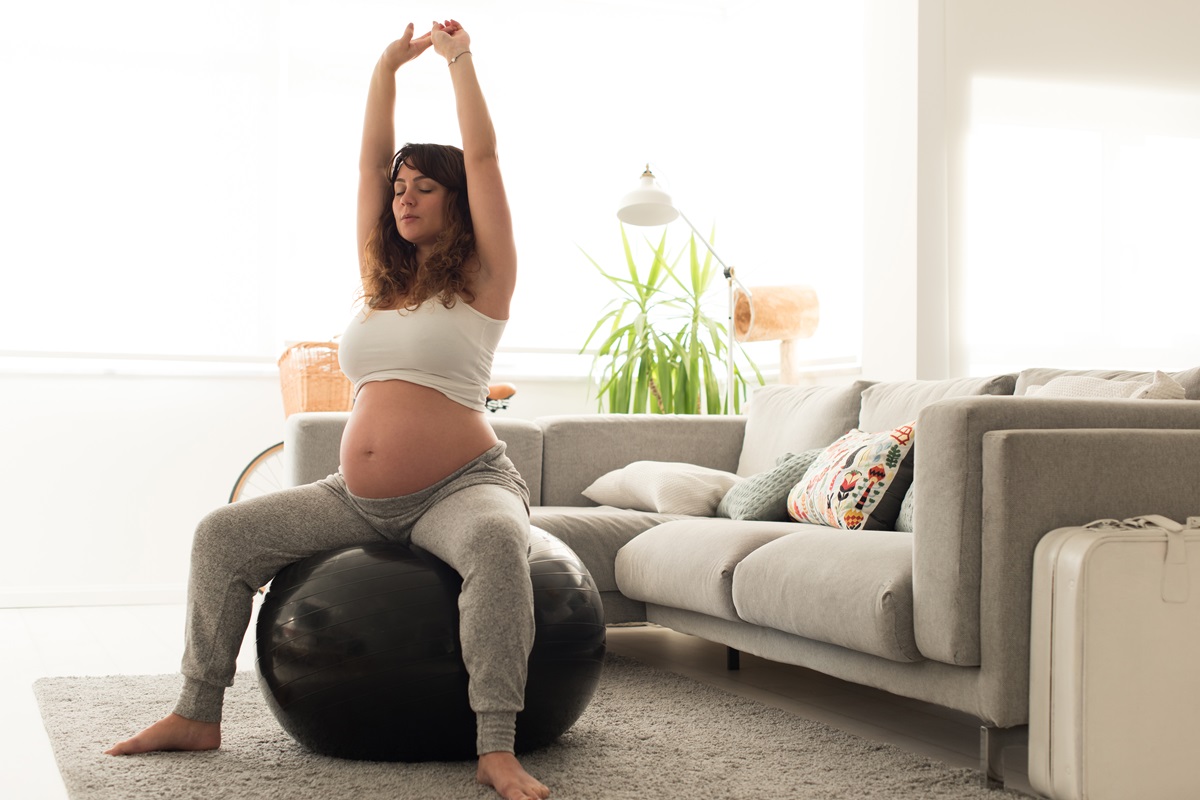
Labour is a process of movement. As your baby makes their way through your pelvis, they need to descend and rotate into a position that allows them to be born. Moving your body and changing positions during pregnancy and labour can help create space for your baby and allow you to work with gravity.
An active labour and birth is about being upright, changing positions and moving in ways that feel comfortable and instinctive. When medically appropriate, staying active during labour may help reduce discomfort, shorten labour and reduce the need for medical intervention. It can also increase blood flow, support your baby’s oxygen supply, make the most of gravity and give your birth support person an active role in your experience.
Helping your baby into an optimal position
The position your baby is in before labour begins can influence how they move through your pelvis during labour. As labour progresses, your baby will usually rotate and descend through the pelvis as they move towards being born.
One position often described as favourable for labour is Left Occiput Anterior (LOA). In this position, your baby’s head is down, their back is towards your left side and facing outwards, allowing them to tuck their chin towards their chest and fit into your pelvis.
Your baby’s head and back are their heaviest parts, so your posture can influence where this weight is directed. Leaning forwards encourages the baby’s weight towards your belly button and an anterior position, while reclining backwards directs the weight towards your spine and a posterior position.
During the third trimester, being aware of your posture and spending time in positions that encourage your knees and belly to sit lower than your hips may help your baby settle into an anterior position.
You can encourage this by:
- Avoiding a slouched or laid-back posture when sitting, including in the car. A small cushion behind your lower back can help you maintain a more upright position.
- Allowing your belly to act as a ‘hammock’ for your baby.
- Allowing your lower back to sway forwards when standing and walking.
- Sitting backwards on a kitchen chair.
- Sitting on an exercise ball, particularly if you work at a desk, as this naturally encourages you to lean forwards.
Being aware of your baby’s position can help you feel more connected with your body and your baby, and allow you to take an active role in preparing for birth.
Did you know that your body and baby work together to prepare for labour and birth?
Letting labour begin on its own supports the spontaneous onset of labour in uncomplicated pregnancies to promote physiological birth, minimise unnecessary medical intervention and support wellbeing of mums and babies. During the final weeks of pregnancy, important changes take place as your body and baby prepare for birth. Hormones help your cervix soften, your uterus prepare for contractions, and your baby get ready for life outside the uterus.
Allowing labour to begin on its own supports these natural processes.
Moving during labour
Once labour begins, movement and changing positions can help your baby descend and rotate through your pelvis. There is no need to stay in one position throughout labour. In fact, alternating between positions can help you find what feels most comfortable as your labour progresses.
Try following your body’s instincts. You might walk, stand, kneel, squat, rock, stretch, dance or use an exercise ball. Your partner can support you through these movements with encouragement, touch or physical support.
Standing
Standing allows you to remain upright and make the most of gravity. It can help your baby descend, support effective contractions and can be particularly useful during the pushing stage.
Kneeling and leaning forwards
Kneeling or leaning forwards can help shift your baby into a favourable position while also providing relief from backache. Pelvic rocking in this position can increase blood flow, help reduce discomfort and encourage your baby to descend.
Leaning forwards can also help open the pelvis and may make contractions easier to manage. You can use the bed, a partner or an exercise ball for support.
Exercise balls
An exercise ball, also known as a fitball or birth ball, can be a useful tool for staying active during labour. Sitting, rocking or leaning over the ball allows you to move your pelvis while remaining supported.
Birth balls can help reduce discomfort, encourage movement and help you and your baby find a comfortable position for labour and birth. They are available in St John of God Health Care birthing suites for use during labour and birth.
What is a peanut ball?
A peanut ball is similar to an exercise ball but has a narrower section in the middle, creating a shape that resembles a peanut.
Peanut balls can be particularly useful if you have chosen or require an epidural and are spending more time in bed. An epidural can limit your ability to move freely and change positions, but a peanut ball can help you maintain some of the pelvic movement and positioning benefits of being upright.
When used while lying down, the peanut ball can mimic a squatting position. Placing it between your legs can help open the pelvis and create more space for your baby to descend and rotate with each contraction.
A peanut ball can also be used simply for comfort when you want to lie down and rest or sleep during labour. Unlike pillows, it is less likely to slip, slide or flatten. It can also be used during pushing and birth if you choose a side-lying position.
Research by Payton (2015) reported that use of a peanut ball was associated with a 90-minute reduction in the first stage of labour and a 22-minute reduction in the second stage of labour for women labouring with an epidural.
Peanut balls can be used by most women, but if you have pelvic instability or pelvic pain, discuss using them with your care provider or physiotherapist.
If you are interested in using a peanut ball, contact your hospital maternity ward to check whether they have them available and consider including this preference in your birth plan.
What is Spinning Babies®?
Spinning Babies® is an approach to birth created by midwife Gail Tully. It focuses on the relationship between your baby’s position and the soft tissues around your pelvis during pregnancy and labour.
Despite the name, ‘spinning’ does not mean manually turning or handling your baby. Instead, the approach focuses on balance, gravity and movement to help create space within the pelvis and encourage your baby to move and rotate through that space.
The three principles of Spinning Babies are:
- Balance - supporting balance of the uterus and pelvis.
- Gravity - using gravity to help your baby move downwards.
- Movement - encouraging movement and a full range of motion.
Spinning Babies encourages daily activities and exercises during pregnancy that aim to support comfortable movement, pelvic stability, supple muscles and connection with your baby.
Three activities known as the ‘Three Sisters’ can be performed at home from the third trimester, as you feel comfortable:
- Belly sifting with a rebozo* - this can be started in mid-to-late pregnancy and used in early labour between contractions.
- Forward-leaning inversion - this can be introduced from around 20–24 weeks and used during pregnancy and early labour for relaxation.
- Side-lying release - this can be started in mid-to-late pregnancy and used in early labour or if labour slows down.
*A rebozo is a long-woven scarf that can be used by a support person to gently warm and relax the abdominal muscles, ligaments and fascia. The technique has a long history in Mexico, where midwives have traditionally used gentle ‘sifting’ movements to provide comfort and encourage movement.
Spinning Babies describes techniques including ‘Sifting’ and ‘Shaking the Apple Tree’ that use the rebozo.
Before beginning Spinning Babies exercises, please speak with your obstetrician or care provider. These exercises are not recommended in some circumstances, including placenta previa, vaginal bleeding, blood pressure issues, hip hypermobility, certain spinal or hip problems, glaucoma or recent abdominal surgery.
Warm water and changing positions
A warm bath or shower can provide another opportunity to relax and move during labour. The buoyancy of the water can make it easier to change positions, while a shower can allow you to remain upright and direct the water onto areas such as your lower back.
Some St John of God Health Care (SJGHC) hospitals have baths available for pain relief during labour. However, certain medical or labour conditions, including the need for continuous fetal monitoring, may mean you cannot use a bath. SJGHC does not perform waterbirths.
Find what works for you
There is no single ‘perfect’ position for labour. Your baby’s position can change, and the position that feels wonderful during one contraction may be completely wrong for the next.
The most important thing is to have options. Try different positions, move regularly, use gravity where you can and listen to what your body is telling you. Your partner and birth support people can help you move, provide physical support and encourage you along the way.
Whether you are standing, kneeling, leaning over a fitball, using a peanut ball, lying on your side or simply swaying through a contraction, every movement is an opportunity for you and your baby to work together.
If you would like to learn more about positioning, movement or antenatal exercise during pregnancy, speak with your obstetrician or a midwife at your hospital. You can also explore the Spinning Babies® resources to learn more about their pregnancy and birth activities.
Further information
Spinning Babies® (https://www.spinningbabies.com/)
Sutton, J. & Scott, P. (1996), Understanding and Teaching Optimal Foetal Positioning, https://www.healthline.com/health/pregnancy/baby-positions-in-womb#turning-baby
Payton, C. L. (2015), Use of the Peanut Ball to Decrease First and Second Stages of Labor, Graduate Theses, Dissertations, and Capstones. Paper 14.
Journal of Perinatal Education, 24(1), 16–24, Reducing Length of Labor and Cesarean Surgery Rate Using a Peanut Ball for Women Laboring With an Epidural
Balaskas, J. (1983), Active Birth, Allen & Unwin Pty Ltd, Australia
https://hypnobirthingaustralia.com.au
Amis, D. (2023). Research update: Healthy birth practice #1—Let labor begin on its own. The Journal of Perinatal Education, 32(2), 72–82. https://doi.org/10.1891/JPE-2022-0030